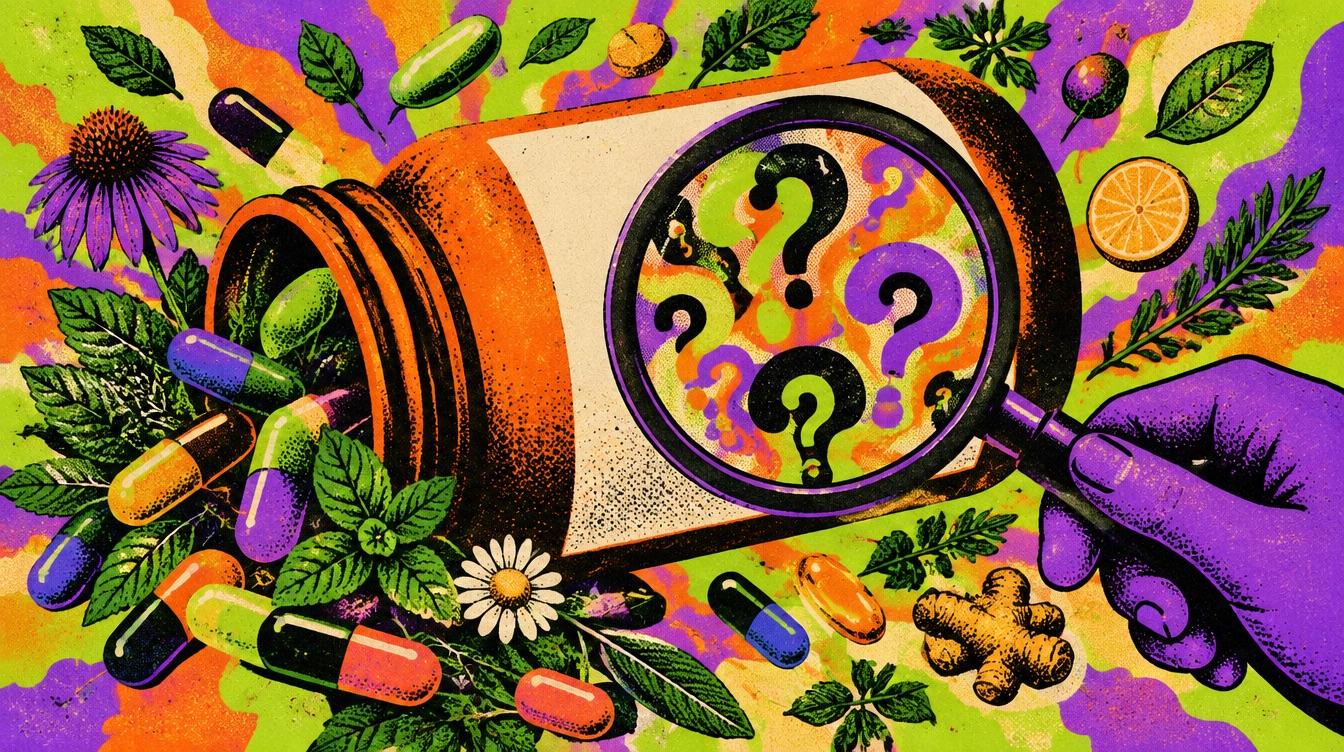
Ask around and you will find it quickly: a friend who has booked acupuncture, a relative who swears by a herbal tea blend, a colleague who has swapped the pharmacy aisle for a practitioner of Chinese or Ayurvedic tradition. Interest in older, non-conventional approaches to health has not faded as modern medicine has advanced. For many people it has grown.
One reason people give, again and again, is trust. This piece looks at that trust gap, at what the main UK health bodies actually say about these practices, and at how to approach them without being either dismissive or naive. It is general information, not medical advice.
The trust gap is real
The pharmaceutical industry is not widely loved. Polling run by Ipsos for the industry’s own trade body, the ABPI, has put public trust in pharmaceutical companies at around a third of people, and that figure has moved only modestly since the pandemic. The same trade body describes perceptions as largely consistent year on year. In other words, the sector knows it has work to do.
The reasons are familiar: arguments about drug pricing and profits, marketing aimed at doctors and patients, and high-profile cases from the past in which companies were found to have played down risks. None of that means medicines do not work. It does mean that some people have lost patience with the businesses that make them, and that distrust of a company can quietly turn into distrust of the whole system.
Why traditional approaches appeal
Distrust is only half the story. The other half is what traditional practices offer in its place.
- Time. An acupuncture or herbal consultation often lasts far longer than a ten-minute GP appointment, and the practitioner asks about sleep, stress, diet and daily life.
- A sense of control. Choosing a practice yourself feels different from being handed a prescription.
- A holistic framing. Many people respond to approaches that treat the person as a whole rather than a list of symptoms.
- Heritage. Traditions with centuries of use carry a credibility of their own, and for many families these are not new trends but long-standing parts of their culture.
- Frustration with waiting. Long NHS waiting lists push some people towards private practitioners they can see this week.
Feeling listened to is not the same as being given an effective remedy. Both matter, and it helps to know which one you are paying for.
What the UK health bodies say
These practices are not all in the same position, and lumping them together is where most arguments go wrong.
Homeopathy is the clearest case. The NHS says there is no good-quality evidence that homeopathy is effective as a treatment for any health condition. In November 2017 NHS England told local commissioners that homeopathy, along with certain herbal items, should not routinely be started for new patients in primary care, citing a lack of robust evidence of clinical effectiveness and, in some cases, safety concerns.
Acupuncture sits somewhere different. NICE’s headaches guideline has said clinicians may consider a course of up to ten sessions over five to eight weeks for people with chronic tension-type headache, and for migraine prevention when standard options are unsuitable or ineffective. Guidance for other uses, such as long-term pain, has been narrower, and NHS access in practice is limited. A cautious reading is that acupuncture has some support for specific uses and less for others.
Herbal medicines are different again, because the category is huge. Some herbal products are registered under the Traditional Herbal Registration scheme, which checks quality, safety and labelling, and approves them for use based on long-standing traditional use rather than on trial evidence. Many other herbal products are sold as ordinary food supplements and do not go through that scheme. The NHS also notes that “natural” does not mean safe, and that some herbal products can interact with prescribed medicines.
The World Health Organization has taken a broader interest. Its 2019 global report on traditional and complementary medicine drew on contributions from 179 member states and was the first to cover products, practices and practitioners together. The report is about how countries regulate and integrate these practices, not an endorsement of any particular remedy.
The risks of replacing rather than adding
Most of the harm in this area does not come from a gentle practice taken alongside normal care. It comes from substitution: delaying a doctor’s appointment, stopping a prescribed medicine without advice, or relying on an untested remedy when something serious is going on. Low trust in a company is not a good reason to skip a diagnosis.
Quality and honesty are the other concerns. Practitioners in many of these fields are not regulated in the same way as doctors, pharmacists and nurses, so it is worth asking about training, insurance and professional membership. Be wary of anyone who promises to cure a disease, who tells you to stop conventional care, or who sells a product at a price that seems detached from its ingredients.
A sensible way to approach it
- Keep your GP in the loop. Tell them, and your pharmacist, about anything you take or try, especially if you are on prescribed medication, pregnant, or have a long-term condition.
- Separate the practice from the product. A relaxing treatment session and a capsule with a long ingredient list raise different questions.
- Check regulation. For herbal products look for the THR mark and registration number, and for practitioners ask which professional body they belong to.
- Treat sweeping claims as a warning sign, and narrow, specific ones as the normal case.
- Report suspected side effects of any product, including herbal ones, through the MHRA Yellow Card scheme.
- Do not stop or change prescribed medicine without advice from the prescriber.
This article is general information. If you are worried about your health, speak to your GP, pharmacist or NHS 111. In an emergency, call 999.
The turn towards older traditions says something real about how people feel about modern healthcare: they want to be heard, to understand what they are taking, and to have some say. The healthiest response is neither to sneer at that nor to abandon the evidence, but to ask of any option, old or new, what it is, who stands behind it, and what the proof looks like.
Sources
- ABPI: Public attitudes on the pharmaceutical industry, will increasing familiarity build confidence? (2025)
- NHS: Homeopathy
- NHS England: Items which should not routinely be prescribed in primary care, policy guidance
- NICE: Headaches in over 12s, diagnosis and management (CG150)
- NHS: Acupuncture
- NHS: Herbal medicines (reviewed 2026)
- MHRA via GOV.UK: Apply for a traditional herbal registration (THR) (updated 2024)
- World Health Organization: WHO global report on traditional and complementary medicine 2019
- MHRA via GOV.UK: The Yellow Card scheme, guidance for healthcare professionals, patients and the public (updated 2025)
This article is for general information and is not medical, legal or financial advice. Laws differ between countries. Read our editorial standards.